
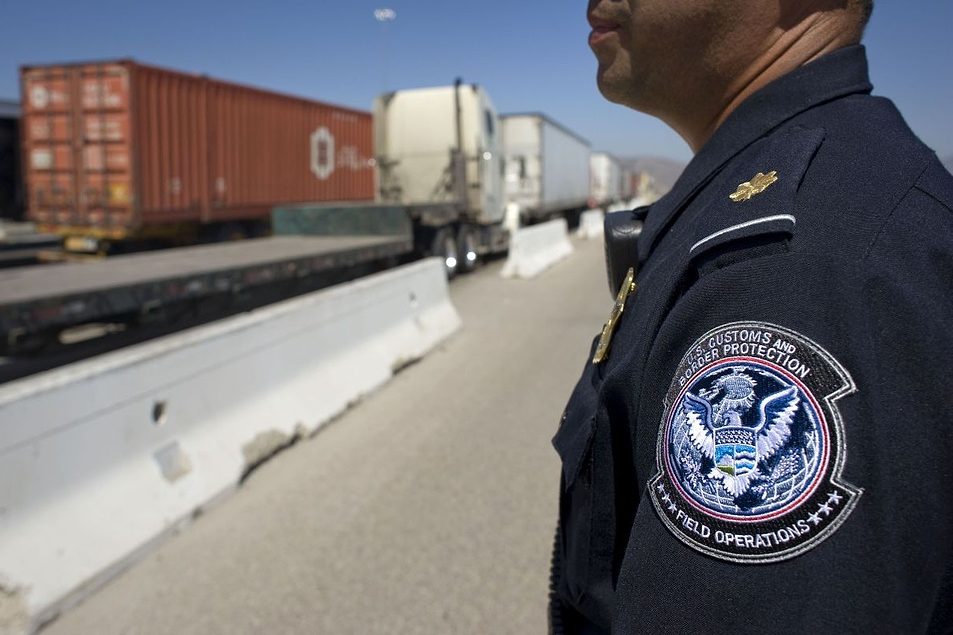
U.S. customs authorities, under pressure to improve enforcement of President Donald Trump’s trade war, are increasingly turning to artificial intelligence to catch tariff dodgers and spot illicit goods before cargo even reaches the country.
New York-based Tru Identity, a trade-compliance automation platform, is working with Customs and Border Protection to develop ways to streamline the goods-entry process and bolster national security, according to a joint statement shared exclusively with Bloomberg.
The announcement underscores how broadly CBP is using new technology to detect bad actors and identify patterns of non-compliance across global supply chains seeing seismic shifts to greater resilience.
“For a long time, the private sector was ahead and got used to it,” Tru CEO Hugo Pakula said. “Now the status quo has flipped, and people need to realize that it’s time to level up or be considered high risk by CBP.”
Under the two-year partnership, “CBP gains insights into the advanced screening tools that Tru’s commercial users rely on, which capture product information that isn’t transmitted on a typical entry filing,” according to the statement.
On the commercial side, businesses using Tru’s tools gain confidence in their declarations to CBP because the agency is using the same universe of data and interpretation of the rules.
Tariff Complexity
Tools that ease uncertainty in the new, more complex trade paradigm are welcome news to most U.S. importers. While Trump sought during the first year of his second term to streamline the federal bureaucracy in the private sector’s favor, his unpredictable and often-changing tariff policies have heaped additional back-office burdens and costs on companies trying to comply.
Businesses have used AI to identify supply chain risks and inefficiencies for years, and CBP has been working with AI-driven supply chain platform Altana since 2023 to identify goods with forced-labor exposure. But compliance and paperwork wasn’t the main focus for most importers until higher tariffs and penalties — and better technology — raised the stakes.
Customs has already stepped up enforcement. In fiscal 2025, the agency recovered about $35 billion from adjusting importers’ tariff bills through a process known as an “entry summary review,” compared with $667.6 million the prior year.
More recently, the agency announced actions aimed at companies linked to forced-labor violations. Even importers in good standing are receiving surprise duty adjustments and having their shipments flagged more often.
“Everybody has been trying to put this off and this is the perfect time for AI to come in, when enforcement is the priority,” Pakula said. “It’s coming in at a pace we’ve never seen before, and I don’t expect it to stop.”
‘Same Sheet of Music’
With about $3.5 billion in new funding for technology and enforcement on its way to CBP from the appropriations bill signed on June 10, trade lawyers and customs brokers across the country are urging clients to be more diligent.
As senior global trade and customs consultant at A.P. Moller-Maersk A/S, the world’s No. 2 container carrier, Janet Labuda works with some of the best-known brands in America. Some of them are wary of AI.
“Some of our clients have said, ‘Well, hang on, how do we trust the data? How do we make sure that it’s correct?’ And I said, ‘The mere fact that Customs is using the same data and using the same approaches, and using the same analytics — at least you’re on the same sheet of music with them,’” she said.
Labuda agrees that AI’s place in trade enforcement is set to grow, and says companies that use it to stay flexible and compliant will be better off.
“If you really do your enforcement right, and you use these tools as tools, it guides you down a particular path for you to ask more questions, for you to delve into a transaction more, for you to understand who’s in your chain and what they’re doing,” Labuda said. “Importers have to be extremely flexible, and their systems have to pivot very quickly.”
That ability to adapt is key in what is still a very uncertain trade environment. The Trump administration is still working on a plan to replace the duties thrown out by the Supreme Court earlier this year, and negotiations with major trading partners remain in flux.
At the same time, the White House is facing pressure to ease tariffs from exporters facing retaliation, and from consumers reeling from high prices. On the flip side, certain industries are calling for more protection from international competition. Still others point out that tariffs may not be having their intended effect.
A report earlier this week from the Coalition for a Prosperous America focused on the various cracks in Trump’s tariff wall.
Trade Diversion
“China has spent years adapting to U.S. tariffs by rerouting supply chains through third countries, and one year after Liberation Day, the data shows just how costly that adaptation has become,” said CPA Senior Economist Mihir Torsekar, who wrote the report. “Nearly a fifth of the Chinese trade that left the U.S. market over the past year shows signs of coming right back in under a different country’s label.”
Wherever tariffs settle and for however long, a new executive order from Trump directing customs authorities to better enforce his trade policies promises even more upheaval.
Among the key changes proposed in Trump’s order is a requirement that domestic and foreign importers meet the same standards for transparency and accountability. Importers will be required to provide ownership details and information about business operations and their supply chain, and maintain good standing with CBP to keep importing.
Customs brokers will also be required to more strongly vet the importers they’re working with. With deadlines set for 45 days, 90 days, 180 days and 12 months, changes are coming quickly.
“Twelve months is not a lot of time when you look at this list of enforcement challenges,” Pakula said.