
NASA has unveiled its historic plans to establish a permanent base on the surface of the moon over the next decade.
NASA, the U.S. National Aeronautics and Space Administration, initially teased at its moon base ambitions in late March, when it pledged to pour $20 billion into a series of manned and unmanned missions, all with the stated aim to gather data on lunar landing systems, and establish a sustainable human presence on the moon. In a May 26 news conference, NASA Administrator Jared Isaacman shared the full timeline the agency has laid out for its planned lunar base.
“The grand return [to the moon] is close at hand, and we will not slow down,” he said. “We are moving with the confidence and purpose to accomplish the missions that only NASA is capable of achieving.”
Read More: The Supply Chain Math Behind Elon Musk’s Moon Base Ambitions
NASA’s plans for a lunar base are divided into three distinct phases, with the first running through 2029, focused on testing technologies on the lunar surface, learning more about what it takes for humans to survive long-term, and to scout out locations for the base itself. The second phase through 2032 will then hone in on assembling permanent infrastructure and establishing logistics operations, with the final phase centered around a goal to establish a sustained human presence.
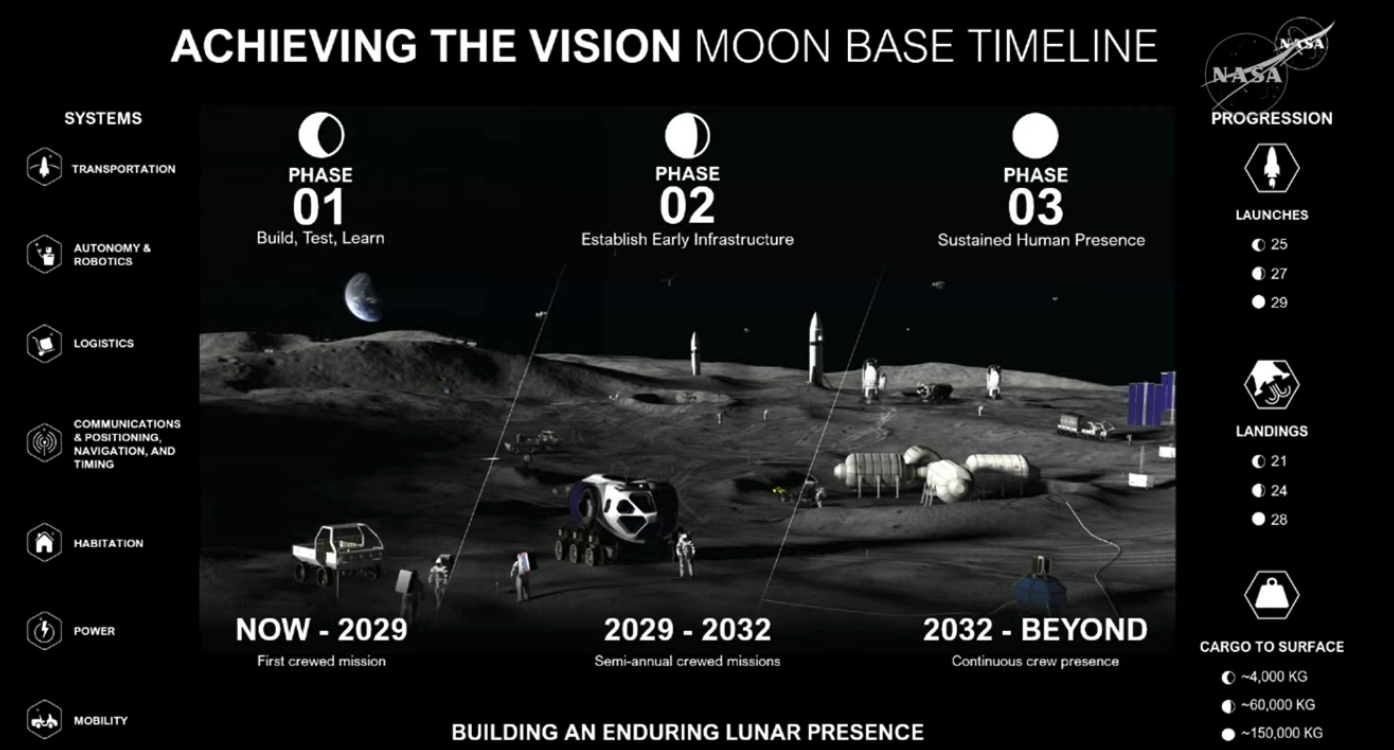
Phase 1 will start with a trio of launches scheduled for 2026. The first — dubbed Moon Base I — will use the first privately funded lunar lander in history. As part of that mission, Blue Origin’s Mark I lander will deliver multiple payloads to the Shackleton Ridge at the moon’s south pole, recognized as a critical area for exploration given that it offers near-constant solar illumination and easy access to nearby dark craters believed to contain water ice.
Next will be the the Moon Base II mission, which will deliver the largest ever commercial payload to the lunar surface, with Astrobotic Technology‘s Griffin lander set to carry more than 500 kilograms of cargo. That cargo will help NASA develop the technologies needed to support lunar terrain vehicles, autonomous operations, and logistics processes for transporting equipment to and from the moon.
The Moon Base III mission will then deliver equipment to study how the lunar surface evolves over time, and how future infrastructure might perform in the moon’s harsh conditions. NASA will also look to uncover the mystery behind “lunar swirls,” strange bright patterns on the moon believed to be linked to localized magnetic fields that may shield parts of the lunar surface from solar radiation.
Through all of this, the larger overarching goal is to ensure that getting to the moon becomes a “high reliability endeavor,” said Moon Base Program Executive Carlos Garcia-Galan. In total, Phase 1 alone will include 25 launches, 21 landings, and the transportation of four metric tons of cargo to the lunar surface.
In early 2028, NASA will also be sending humans to moon’s surface for the first time since 1972, as part of its Artemis IV mission. Astronauts will land somewhere on the moon’s south pole, where they’ll collect geological samples, run experiments, and test out the manned technology the agency will hope to eventually build on for its lunar base down the line.