
CEOs don’t trust their supply chain execs to lead them into an AI-empowered future, warned Atul Dighe, VP Analyst at Gartner, in a presentation at the Gartner Supply Chain Symposium/Xpo.
Dighe acknowledged this might come as a surprise to chief supply chain officers, who understandably argue they’ve been the go-to experts when it has come to handling massive changes in business, such as e-commerce and the COVID pandemic.
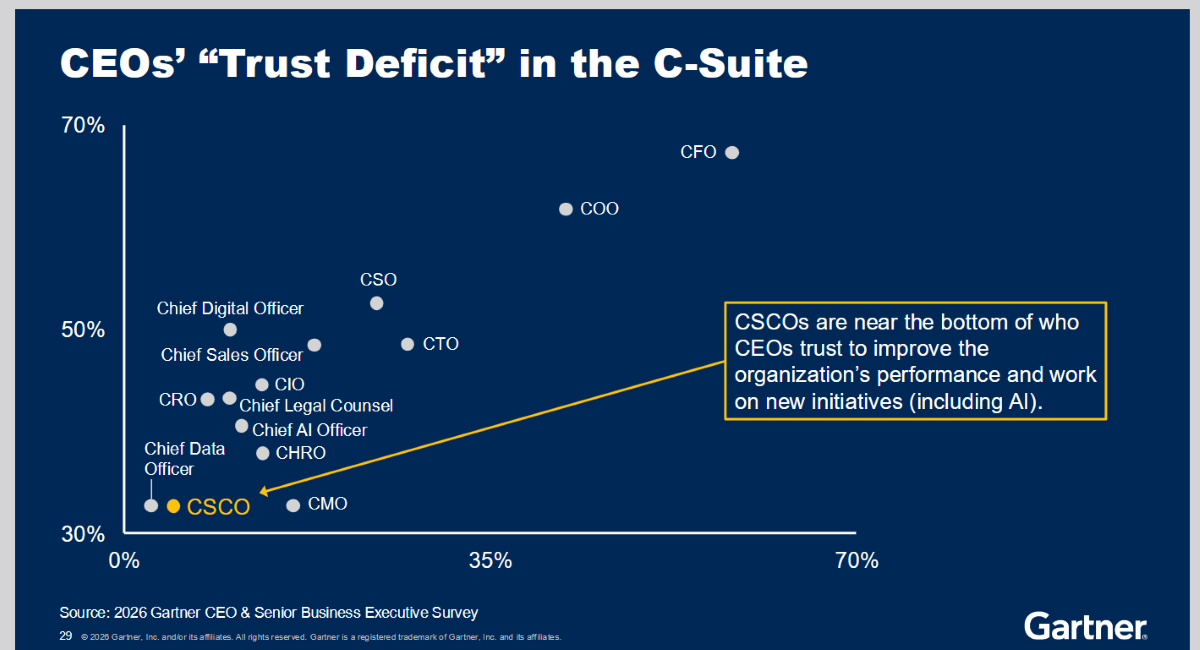
But Gartner research shows CEOs rank CSCOs near the bottom when it comes to trusting internal C-suite executives to improve the organization’s performance and work on new initiatives (including artificial intelligence).
Part of the problem may be a disconnect in priorities, said Dighe. CEOs tend to be focused, as ever, on growth, whereas CSCOs are ducking and weaving risks while the World Uncertainty Index is higher than it was, even, in 2010 and 2021.
But what’s really important to understand, Dighe said, is that CEOs are feeling terribly alone and unsupported. “Leading in today’s environment is no joke. It’s never been more challenging,” he said, quoting Green Day frontman Billie Joe Armstrong’s lyrics from “Boulevard of Broken Dreams.“
“I walk a lonely road… Sometimes, I wish someone out there will find me. ‘Til then, I walk alone.”
CEOs are quitting or being ousted in unprecedented droves, Dighe pointed out. The average length of tenure of a CEO at a Fortune 100 company is less than nine years, with 40% managing only five. “Some CEOs are just ‘out’,” said Dighe, during his presentation in Orlando, Florida, on May 5.
They’re daunted by the changes going on, often unable to keep up. Gartner research shows that almost half of CEOs have lowered their risk appetite, with some 40% reducing their presence in countries or regions, or exiting them entirely. The Conference Board’s CEO Confidence Index, at 49.6, shows they are hesitant to act, Dighe said. But what they urgently need to do is to rethink supply chain and operations to avoid tariffs and reduce spending. CSCOs could help them set a confident balance between innovation and risk.
This is true especially when it comes to AI. “We think that AI is the future, but we’re not sure we’re ready for it,” said Dighe. “AI is the boldest bet we’ve ever made as a society, but we’re not getting ROI. Maybe it’s because of false promises. Maybe it’s not what we thought it would be. It’s not just a new thing; it’s a new way of doing everything.”
CSCOs are perfectly positioned, in theory, to help navigate the uncertain waters ahead. “Supply chain has led companies through so many changes, but CEOs don’t trust you!” he warned, pointing out that CFOs rank top in terms of CEOs’ trust among international executives. That needs to change. “You’ve got to work on this trust gap,” Dighe urged.
The solution is to focus on becoming more influential. “Influence is the currency of trust,” said Dighe. “How do you get a seat at the table? Learn to tell stories — good stories, new stories, forward-leaning stories that focus on business performance. Less spreadsheets. More customer impact stories.”
CSCOs should reimagine their roles in the company. “Become the chief future officer,” Dighe advised. “Join your CEO on their lonely journey.”