
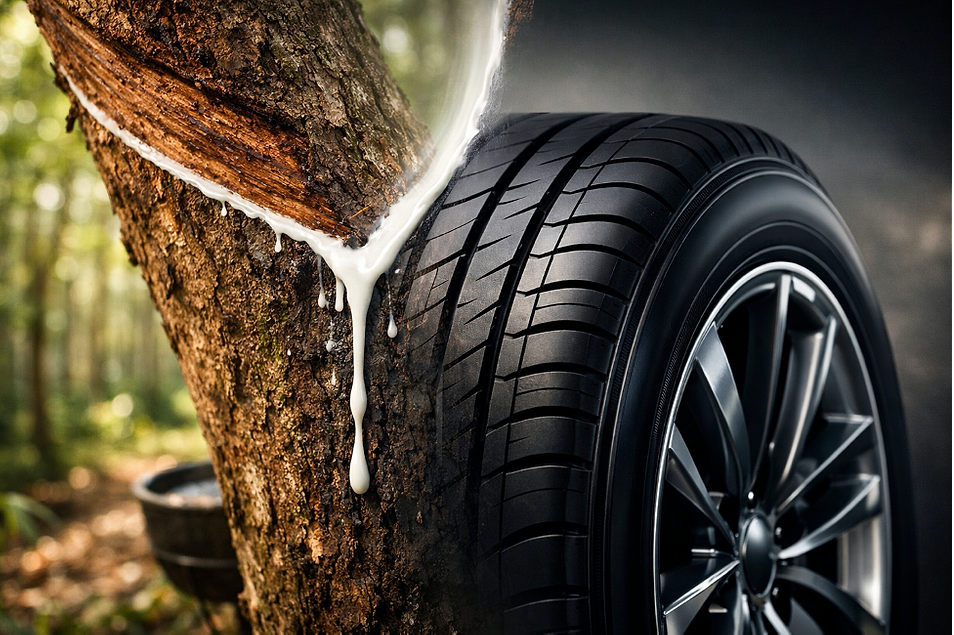
The automotive tire industry faces unprecedented supply chain disruptions, as raw material prices swing wildly and geopolitical tensions reshape global sourcing. Building resilient supply chains means balancing cost efficiency with flexibility, while meeting sustainability demands that shape consumer purchasing decisions. As manufacturers increasingly invest in sustainable tire materials, the industry is discovering that environmental responsibility and supply chain resilience often go hand in hand.
Tire manufacturing depends on a complex blend of materials that must converge at precisely the right moment. Natural rubber, synthetic rubber, steel cord, carbon black, silica and specialized chemical compounds create dependencies across multiple continents and industries.
Natural rubber sourcing presents the most significant challenge. Southeast Asia produces approximately 85% of the world’s natural rubber, with Thailand, Indonesia and Malaysia dominating production. This geographic concentration creates inherent risk. When leaf blight disease affects rubber plantations or monsoons delay harvests, the entire industry feels the impact within weeks.
Synthetic rubber ties tire manufacturers to petroleum markets, creating another layer of volatility. As crude oil prices fluctuate, so do the costs of butadiene and styrene, the building blocks of synthetic rubber. A $10 increase in crude oil prices can raise production costs for passenger car tires by 8% to 12%, squeezing margins across the industry.
Steel prices add yet another variable. The steel belts that give tires their strength and durability represent 15% to 20% of raw material costs. Trade disputes, tariffs and capacity constraints in steel production ripple through to tire pricing, sometimes with just days of notice.
Geographic Concentration Risks
The smallholder nature of natural rubber production amplifies supply chain fragility. Unlike large-scale agricultural operations with sophisticated weather forecasting and disease management, smallholder farmers have limited resources to buffer against shocks. When disease or weather events strike, there’s no strategic reserve to tap.
This concentration also creates geopolitical exposure. Political instability in any major producing region can disrupt supplies for months. The 2021 protests in Thailand demonstrated this risk, temporarily constraining rubber exports and forcing manufacturers to scramble for alternative sources.
Forward-thinking tire manufacturers are expanding their supplier networks beyond the traditional Southeast Asian triangle. African nations such as Côte d’Ivoire and Cameroon are emerging as alternative sources, offering both geographic diversification and ethical sourcing opportunities through certified sustainable rubber programs.
Some manufacturers are investing directly in rubber plantations, creating vertically integrated supply chains that provide greater control over quality and availability. While capital-intensive, this strategy insulates companies from spot-market volatility and ensures supply during periods of scarcity.
Passenger car tires, which represent the largest segment of the market, benefit most from these diversification strategies. The high-volume nature of this segment makes supply certainty paramount; even brief production stoppages can cost millions in lost revenue and damage customer relationships.
Technology-Enabled Visibility
Supply chain visibility has become a competitive necessity. Manufacturers are deploying internet of things sensors throughout their supply chains, tracking everything from rubber tree sap production to containership locations in real time.
Advanced analytics platforms now process this data to predict potential disruptions before they occur. Machine learning algorithms analyze weather patterns, political developments, port congestion and price trends to provide early warnings. One major manufacturer reports that predictive analytics reduced supply disruptions by 34% in 2024 compared to 2022.
Blockchain technology is gaining traction for ensuring traceability, especially for sustainable sourcing claims. Consumers increasingly demand transparency about where their passenger car tires come from and whether they’re produced ethically. Blockchain provides immutable proof of sourcing that builds brand trust while also improving supply chain coordination.
Strategic Inventory Management
The just-in-time inventory model that dominated manufacturing for decades is being reconsidered. While lean inventories minimize working capital requirements, they leave companies exposed when disruptions strike.
Leading manufacturers are adopting hybrid models that combine JIT efficiency for stable materials with strategic buffers for high-risk inputs. Natural rubber now typically carries 60-90 days of safety stock, up from the 30-day standard that prevailed before 2020. This additional inventory costs money, but it’s proven invaluable during recent supply shocks.
Digital twins — virtual replicas of physical supply chains — allow companies to model multiple scenarios and optimize inventory placement. By simulating disruptions, manufacturers identify which materials need buffers and where to position them for maximum benefit. This sophisticated approach maintains capital efficiency while building resilience.
The Circular Economy Opportunity
Sustainability is becoming a supply chain advantage. Tire recycling and retreading programs create closed-loop systems that reduce dependence on virgin materials while appealing to environmentally conscious consumers.
The European Union’s upcoming regulations requiring minimum recycled content in passenger car tires are pushing the entire industry toward circular models. Manufacturers investing now in recycling infrastructure will gain competitive advantage as these regulations expand globally.
Devulcanization technology, which breaks down used rubber for reuse, has improved dramatically. Some manufacturers now incorporate 15% to 20% recycled rubber into new tires without compromising performance, reducing their exposure to natural rubber price volatility.
Certified sustainable rubber programs do more than satisfy corporate social responsibility goals; they improve supply chain resilience. Farms participating in certification programs typically have better agricultural practices, leading to more consistent yields and higher-quality rubber.
The Global Platform for Sustainable Natural Rubber brings together tire manufacturers, rubber producers, and NGOs to improve sustainability across the supply chain. Members report that certified sustainable rubber comes with lower quality variation and fewer supply interruptions compared to commodity rubber.
New Materials, New Challenges
Electric vehicles demand different performance characteristics from passenger car tires. Lower rolling resistance to maximize range, higher load capacity to handle heavy battery packs, and reduced noise all require formulation changes that impact raw material sourcing.
Silica demand is rising as manufacturers reformulate compounds for EV-specific tires. This shifts sourcing priorities and creates new supplier relationships. Some companies are establishing long-term contracts with silica producers to secure capacity as EV adoption accelerates.
The shift also creates opportunities. Lighter-weight tire designs using advanced materials can reduce both vehicle energy consumption and raw-material usage, improving both sustainability and supply chain resilience through reduced material intensity.
Manufacturers are redesigning supply chains with EV growth projections in mind. This means building relationships with suppliers of specialized compounds and materials that traditional internal combustion engine vehicles didn’t require in large quantities.
The fastest-growing segment, passenger car tires for EVs, demands closer collaboration between tire manufacturers and automakers. Co-development arrangements are becoming common, with tire companies involved earlier in vehicle design to ensure optimal integration.
Following are some frequently asked questions and answers about tire supply chains:
What’s the biggest supply chain risk facing tire manufacturers today? Geographic concentration of natural rubber production in Southeast Asia represents the most significant single risk. With 85% of supply from three countries, any major disruption in that region can severely impact global tire production within weeks.
How much does raw material volatility impact tire prices? Raw materials represent 60% to 70% of tire production costs. A 20% swing in rubber or oil prices can change finished tire costs by 12% to 15%, though manufacturers often absorb some volatility to maintain competitive pricing.
Are sustainable sourcing practices more expensive? Initially yes, with certified sustainable rubber typically costing 5% to 10% more. However, quality consistency and supply reliability often offset these costs through reduced waste and fewer disruptions. Long-term contracts with certified suppliers also provide price stability that mitigates market volatility.
How long does it take to diversify a tire supply chain? Meaningful diversification requires 18-36 months. Qualifying new suppliers, testing materials, adjusting formulations and building logistics infrastructure all take time. This is why leading manufacturers started diversification efforts years before recent disruptions made the need obvious.
Following are some key strategies for building tire supply chain resilience:
- Geographic diversification: Expand supplier networks beyond traditional Southeast Asian sources to include emerging regions in Africa and South America.
- Technology investment: Deploy IoT sensors, predictive analytics and blockchain for real-time visibility and disruption forecasting.
- Strategic inventory buffers: Maintain 60-90 day safety stock for high-risk materials while keeping JIT practices for stable inputs.
- Sustainable sourcing programs: Partner with certified sustainable rubber producers who offer both ethical sourcing and improved supply reliability.
- Circular economy initiatives: Invest in recycling and retreading infrastructure to reduce virgin material dependence.
- Collaborative planning: Strengthen partnerships with key suppliers through long-term contracts and shared risk management.
- Scenario modeling: Use digital twins to simulate disruptions and optimize inventory placement and supplier mix.
- Material innovation: Develop formulations that use alternative materials or recycled content to reduce exposure to volatile commodity markets.
Supply chain resilience in tire manufacturing requires a fundamental shift from cost optimization to risk-balanced strategies. The manufacturers thriving today are those who invested early in diversification, technology and sustainability, building flexibility that withstands both market volatility and unexpected disruptions.
The path forward demands continuous adaptation. As electric vehicles reshape demand, as sustainability regulations tighten, and as geopolitical tensions evolve, tire supply chains must remain agile. Companies that embrace this challenge will not only survive the next disruption; they’ll emerge stronger and more competitive.
Enrica Clavito is an SEO specialist at Seirim.