
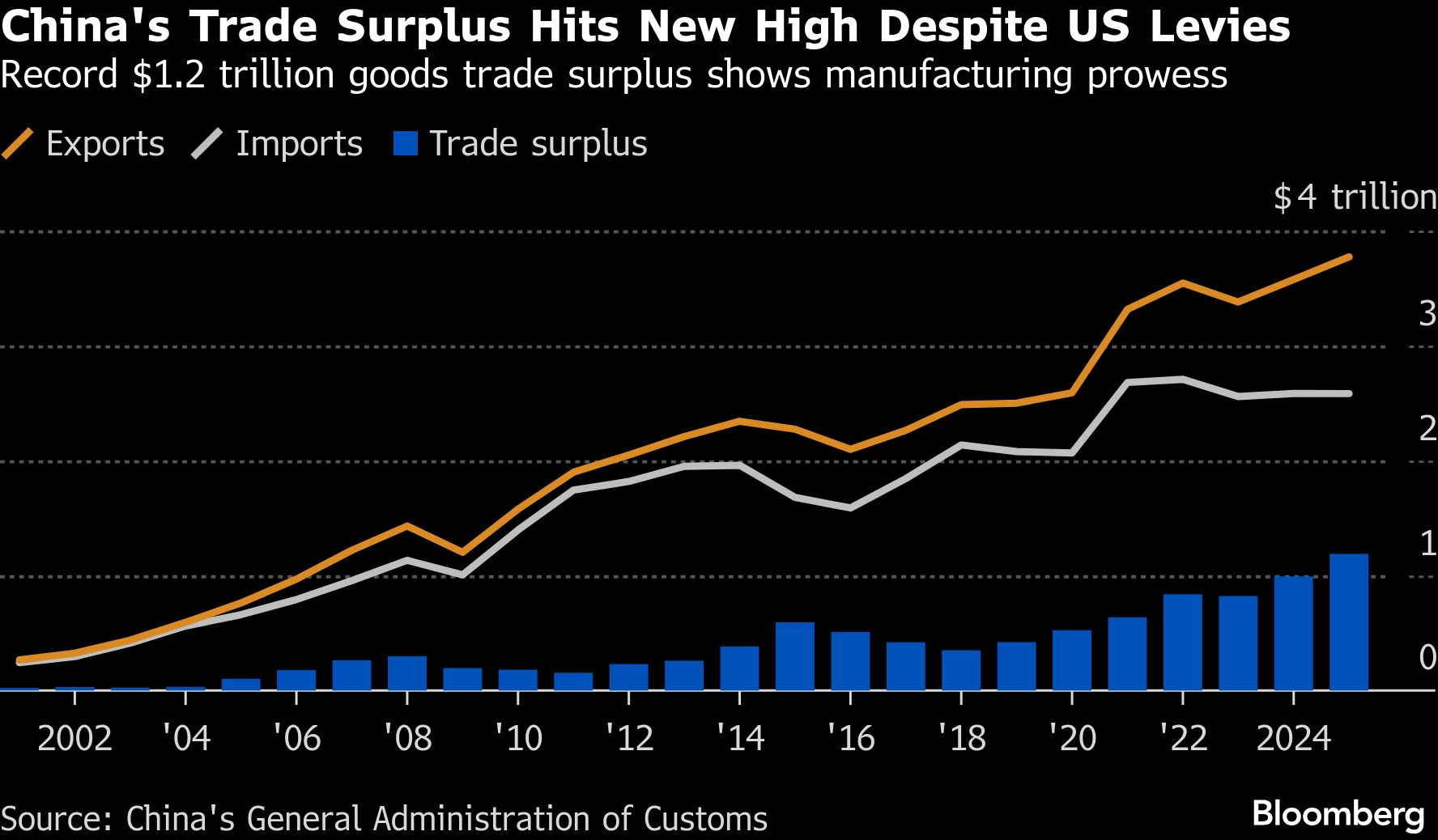
China’s exports ended last year with a growth spurt and sent its trade surplus to a record $1.2 trillion in 2025, extending a boom that’s seen factories escape Donald Trump’s tariffs by making deeper inroads into markets beyond the U.S.
The resilience was the biggest surprise for an ailing Chinese economy last year and could cushion it in the months to come. Defying expectations for a slowdown, exports picked up last month — a feat given a high base of comparison from a year ago, when Trump’s re-election to the presidency sparked panicked front-loading of orders.
The 6.6% gain in December 2025 was the quickest in three months, official data showed on Wednesday, and faster than any forecast in a Bloomberg survey of economists.
“We expect export resilience to extend into this year, with exports remaining an important growth driver and partially offsetting weaker domestic demand,” Barclays Plc economists including Ying Zhang wrote in a report.
The combined increase in shipments to Southeast Asia and Europe more than offset a deepening contraction in sales to the U.S. last year.
A surge in exports of high-end goods shows the headway China has made in moving up the value chain, which also led to its shrinking imports for products like cars. And as supply chains shift overseas, the construction of factories elsewhere — partly driven by Chinese investment — is pushing up demand for Chinese components, equipment and machinery.
What Bloomberg Economics Says…
“China’s stronger-than-expected export growth in December shows its export engine continued to support the economy in the final quarter of 2025 when domestic drivers weakened. Higher shipments to non-U.S. markets again more than offset the tariff-driven slump in exports to the U.S. Looking ahead, export resilience is likely to extend into 2026.”
— Eric Zhu.
The factors driving China’s booming trade and large surpluses are unlikely to fade soon.
The country’s current account surplus — a measure of trade in goods and services — was projected by the International Monetary Fund at 3.3% of gross domestic product last year. That would be the highest level since 2010, when the country’s last great export upswing was tapering off following its ascension into the World Trade Organization in the early 2000s.
The swelling trade surplus also underscores the imbalance between China’s manufacturing strength and stubbornly weak domestic consumption. It’s a vulnerability likely to persist into this year and beyond.
While exports have powered the world’s second-biggest economy, its years-long property slump and falling investment are restraining the country’s appetite for foreign goods, reducing imports such as crude oil. Deflation at home also led to depreciation of the yuan in inflation-adjusted terms, making Chinese products more appealing elsewhere.
Global Backlash
But as China navigates tariffs and growing economic protectionism around the world, it’s stirring anxiety abroad as it pours exports into Africa, Latin America and beyond.
Chinese authorities are taking steps to address the rising trade tensions, including by reducing export tax rebates for hundreds of products such as solar cells and batteries. In another sign of easing frictions, the European Union is considering a minimum price system for Chinese electric vehicles to replace import tariffs.
As exports surge ever higher, the domestic implications are also far-reaching. The strength of external demand will likely weaken the urgency for Chinese policymakers to boost domestic consumer spending and investment.
Nomura Holdings Inc. economists expect Beijing to introduce major stimulus for the economy only in the second quarter of 2026 as a result of it. It’s also possible that the central bank could further delay a cut to its policy rates or lenders’ reserve requirement ratio, according to Citigroup Inc.
While there are growing calls for China to strengthen the yuan in order to reduce its trade imbalances, authorities will likely only endorse gradual gains in the currency. Without an improvement in domestic demand, a rapid appreciation of the currency could harm the economy by further deepening deflation pressure because it would make imports cheaper.
Other risks abound. This week, Trump announced new tariffs on goods from countries trading with Iran, threatening to derail his one-year truce with China, the world’s top buyer of Iranian oil.
In addition, tensions over the influx of goods are building with major partners such as Europe. And a high base of comparison last year means export growth will come under more pressure in the months ahead.
“The external environment for China’s trade development is still grim and complex” in 2026 due to slower global economic growth and geopolitical fragmentation, Wang Jun, deputy head of the customs authority, said during a briefing in Beijing on January 14. But “with more diversified trading partners and strengthened resilience, the fundamentals of China’s trade remain solid,” he said.
Exports of higher-value goods surged in 2025, with products including semiconductors, cars and ships recording gains of more than 20% from a year ago. Meanwhile, some lower-end exports such as toys, shoes and clothing contracted.
Lynn Song, chief economist for Greater China at ING Groep NV, warned China is facing “some pushback” as its higher-end products become more competitive globally.
“The key to continuing win-win cooperation is to boost China’s domestic demand and support imports,” he said. Overall, the stronger-than-forecast figures are “an encouraging sign for China as well as trading partners, given we were looking at a potential deceleration due to last year’s frontloading effect.”