
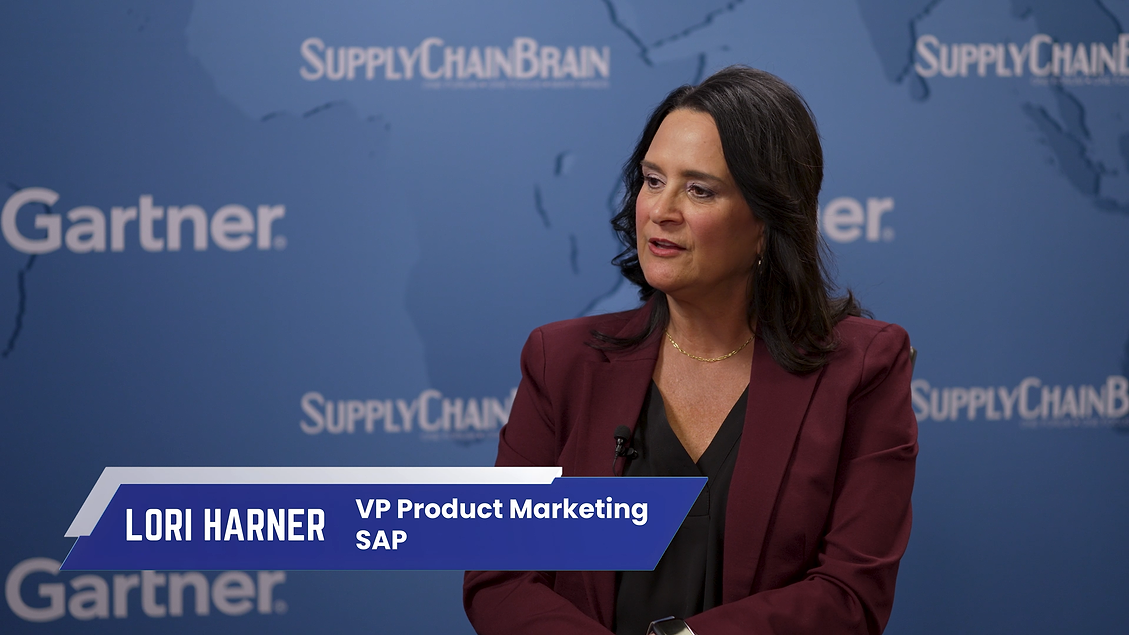
Artificial intelligence is making its mark in supply chain planning, but to ensure success it needs to be combined with the right data and supporting applications, says Lori Harner, vice president of product marketing with SAP.
Some form of AI has been deployed in supply chain planning for years, Harner says. But it’s only with the arrival of agentic AI that the technology is realizing its potential to make the planning function more accurate and efficient.
Agentic AI goes beyond simply augmenting tasks to handling actual functions and helping in the planning process. Cross-organizational agents are making possible true end-to-end supply chain planning. As a result, Harner says, “we’re going to see a great revelation in the way planners interact, using both humans and agentic AI.”
For all its promise, AI is of little value as a standalone tool. In order for the technology to have a real impact on supply chain planning, businesses first need the right data and applications, which AI can then “orchestrate.” “[AI] alone is not good enough,” she says.
AI can be applied to multiple applications, including planning, transportation and warehousing, using data to make informed decisions. Yet despite the “autonomous” characterization of agentic AI, humans remain in the loop, Harner says. Agents can do “a lot of heavy lifting,” but it’s people who continue to make the ultimate planning decisions.
That said, the role of the human planner will definitely change. “The planner of today doesn’t necessarily look like the planner of the future,” Harner says.
Many AI projects stumble at the starting gate because users fail to achieve an understanding of which processes they want to automate. “AI has to be a journey that they’re on,” Harner says, “and willing to take.”