
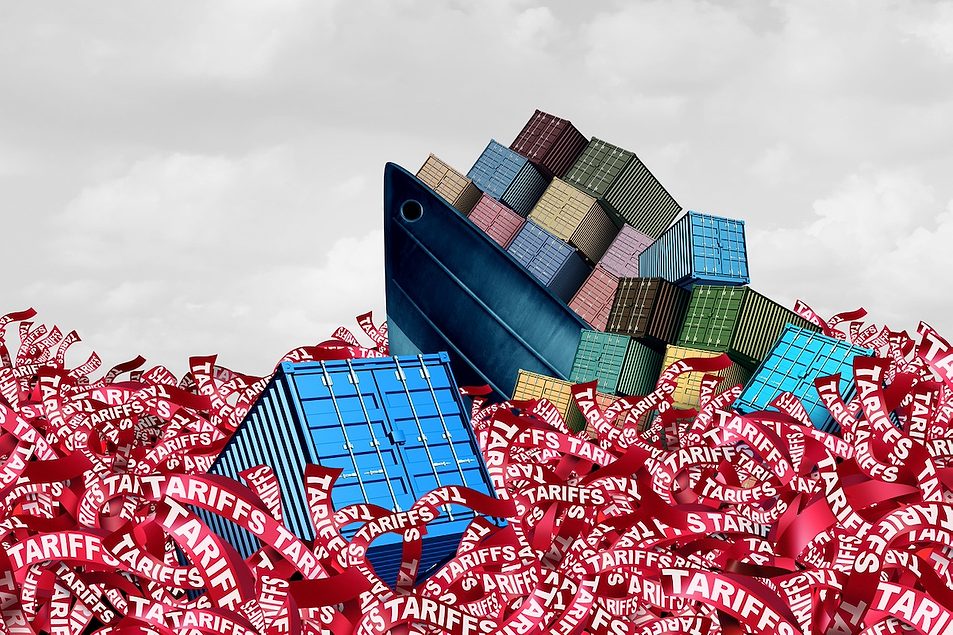
For decades, sourcing decisions in manufacturing hinged on a deceptively simple question: Which supplier offers the lowest unit cost? That question is now obsolete, or at least dangerously incomplete. The tariff environment that took shape throughout 2025 and into early 2026 has rendered static unit-cost comparisons unreliable as the primary basis for awarding contracts, allocating volumes, or designing supply networks. In its place, a more rigorous construct is gaining traction among procurement and operations leaders: tariff-adjusted landed cost, modeled across multiple trade-policy scenarios and weighted by probability.
The shift is not academic. U.S. effective tariff rates climbed to roughly 17% in 2025, the highest sustained level since the 1930s. U.S. customs authorities collected approximately $287 billion in tariff revenues and associated fees: a 192% year-over-year increase. The pace of change was at least as disorienting as the magnitude. Tariff rates on Chinese imports shifted from 10 to 20% in the span of weeks. A 10% baseline duty on virtually all imports was introduced in April. Steel and aluminum duties doubled by midsummer. Section 301 tariffs continued to layer additional costs on top of reciprocal rates in certain product categories. Bilateral negotiations with the EU, South Korea, India and Brazil each produced distinct rate structures that evolved on different timelines.
In this environment, a sourcing model built on a single, fixed set of duty rates is not just imprecise, but is also structurally unable to capture the actual cost exposure of a purchase decision. The traditional landed-cost formula (product cost plus shipping, customs duties, insurance and overhead) still forms the backbone of any analysis. What has changed is that the customs-duty variable can no longer be treated as a static input. It must be treated as a range, informed by scenario analysis, and updated continuously.
From Spreadsheet to Simulation
The operational consequence of this recognition is significant. Procurement teams that once ran landed-cost models in spreadsheets on an annual or quarterly cycle are now being asked to maintain dynamic models that can be rerun in hours when a new executive order is issued, or a bilateral agreement is announced. The analytical infrastructure requires clean tariff classification data, HS-code-level granularity, real-time duty rate feeds, and supplier-specific cost breakdowns. However, possessing this infrastructure is non-trivial to build. Most organizations do not yet have it.
A Gartner survey conducted in early 2025 found that 92% of supply chain executives cited increased costs as the primary concern related to tariffs, yet only 39% were actively re-evaluating supply locations, suggesting a gap between awareness and structural response. More telling, 74% of procurement leaders acknowledged their data was not ready to support AI-driven sourcing decisions, let alone the scenario modeling that tariff-adjusted landed cost assessments demand.
This data-readiness gap is the real bottleneck. The concept of weighting landed-cost scenarios by probability is intellectually straightforward: Assign each plausible tariff regime a likelihood, calculate landed cost under each regime for every supplier, and select the sourcing allocation that minimizes expected cost across the probability distribution rather than under any single assumption. The execution, however, requires procurement to gather accurate, HS-code-level tariff classification for every SKU, reliable country-of-origin data extending into sub-tier supply, and the ability to integrate freight, insurance and compliance cost data into the same model. Few organizations can do all three today.
What a Scenario-Weighted Model Looks Like in Practice
Organizations further along this curve tend to structure their models around three to five discrete tariff scenarios, each reflecting a plausible trade-policy outcome over a defined time horizon, typically 12 to 24 months. For a manufacturer sourcing stamped metal components, for example, the scenarios might include a baseline of current rates holding steady, a negotiated bilateral reduction (as occurred with South Korea’s tariff dropping from 25 to 15% in late 2025), an escalation pathway (such as the scheduled rise in Chinese tariff rates to 44% by November 2026), and a retaliatory scenario in which key suppliers face counter-tariffs from other governments.
Each scenario is assigned a probability weight, as a structured judgment informed by trade-policy analysis, legal proceedings and geopolitical intelligence. The supplier’s landed cost is then calculated under each scenario, and the volume allocation is optimized against the weighted average. This is fundamentally different from the traditional approach of picking the supplier with the lowest cost under today’s tariff rates, and simply hoping those rates hold.
The practical benefit is not just avoidance of costs. It is the speed of decision-making. When the U.S. imposed 100% duties on Chinese electric vehicles in mid-2025, organizations that had already modeled escalation scenarios were able to activate pre-identified alternative sourcing plans within days. Those that had not were forced into reactive, often more expensive, responses. As a result, scenario-based sourcing strategy must become standard practice, as an operational capability that allows organizations to perform acceptably across a wide range of conditions.
The Organizational Challenge
Adopting this tariff-adjusted landed cost as a primary metric requires more than new software or better data. It requires a change in how sourcing decisions are governed. In many organizations, procurement, trade compliance, finance and operations each own a piece of the landed-cost puzzle, but lack a shared model or decision framework. Procurement knows the supplier’s quoted price. Trade compliance knows the HS code and applicable duty rate. Finance knows the carrying cost of inventory. Operations knows the lead-time and logistics implications of each supplier. No single function sees the full picture, and the traditional sourcing process (awarding contracts primarily on unit price) does not force these inputs to combine intelligently.
The companies making the most progress are those that have established cross-functional landed-cost teams, often reporting to a VP of supply chain, or a chief procurement officer with a broadened mandate. These teams maintain a shared model, update it on a defined cadence (often monthly, with ad-hoc updates triggered by policy changes), and use it as the primary input for sourcing decisions. The model’s output is not a single number but a distribution: a range of probable landed costs, with explicit identification of which scenarios create the greatest risk exposure.
What This Means for Small and Medium-sized Enterprises (SMEs)
An honest assessment of this transition must acknowledge its uneven accessibility. Large multinationals with dedicated trade compliance teams and enterprise resource planning systems that integrate tariff data can build scenario-weighted models, even if the process is slow and expensive. Small and mid-sized manufacturers face a steeper climb. According to a 2025 survey by the National Association of Manufacturers, 30% of small and mid-sized enterprises reported cash-flow difficulties stemming from tariff costs, and World Bank data suggests that SMEs pay significantly more per unit to ship internationally than their larger competitors, primarily due to an inability to aggregate volume or access preferential trade financing.
For these firms, the path to scenario-weighted landed cost may begin not with enterprise software but with disciplined manual processes: maintaining a spreadsheet-based model with two or three scenarios, reviewing it monthly, and using it to pressure-test key sourcing decisions before committing volume. Industry consortia and open-source tariff tools, such as those being developed by the Digital Container Shipping Association, may also help democratize access to trade intelligence that is currently concentrated among the largest firms.
The Metric Shapes the Network
There is a broader strategic implication. If the primary sourcing metric shifts from lowest unit cost to tariff-adjusted, scenario-weighted landed cost, the supply networks that result will look different. They will be more geographically distributed, with deliberate redundancy built into critical categories. They will favor suppliers willing to share tariff exposure or invest in compliance infrastructure. They will embed optionality (i.e., the ability to shift volume between qualified suppliers in different jurisdictions as duty rates change) as an explicit design criterion rather than an afterthought.
This is the deeper structural shift underway. The tariff volatility of 2025 was not a temporary disruption to be waited out. The economic effects of reshoring, shifting trade lanes, and supplier relocation will persist long after any individual tariff is raised or lowered. The organizations that recognized this earliest, and retooled their sourcing metrics accordingly, are building supply networks designed for the world as it actually is, rather than the one their legacy models assumed.
The lowest-unit-cost era is over, because unit cost alone is no longer sufficient to make a good decision. Tariff-adjusted landed cost, modeled dynamically and evaluated across plausible scenarios, is the metric that reflects this reality. The question for sourcing leaders is not whether to adopt it, but how fast they can build the data, the models and the cross-functional governance to make it operational.
Fotis Konstantinidis is digital & data analytics practice leader at Stout.