
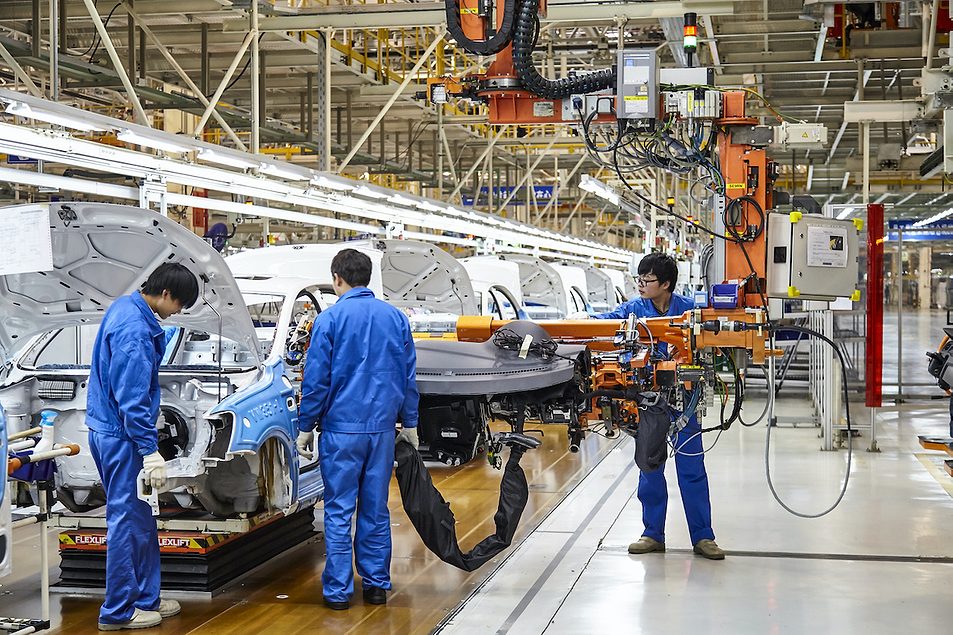
Conventional wisdom of recent years says China is losing its grip as a manufacturing powerhouse. Rising wages for Chinese workers, seesawing U.S. tariffs, geopolitical strife and the cost of shipping to distant markets are all cited as reasons for bringing production back to the western hemisphere.
But what if there’s something about the very nature of Chinese manufacturing that continues to put the American model at a disadvantage?
Allan Evans thinks so. He is chief executive officer of Unusual Machines, a U.S.-based manufacturer of drone parts for military and commercial use. As such, he competes directly with Chinese producers on many products.
Evans spent a decade in China launching virtual-reality headset production lines, to the tune of tens of thousands of units a year. He’s seen first-hand how Chinese factories manage suppliers, components, finished goods and workers on the floor. And he says the reality of that world today is different from how many westerners perceive it.
In the early years of the Chinese manufacturing boom, factories would be largely staffed with workers from rural communities, traveling thousands of miles to major production centers such as Shenzhen. They would live onsite in dormitory-like conditions, only returning to their villages and families at Chinese New Year, in has been described as the planet’s biggest human migration.
That’s not the whole picture anymore, Evans says. China’s urban centers now are home to many factory workers and a growing middle class. It’s a younger demographic, availing itself of the benefits of the internet economy and digital conveniences. “China, in the last 30 years, has done the greatest job in the history of the world in destroying poverty,” Evans says.
Today’s Chinese factory worker possesses an enthusiasm for the job that’s not easily replicated in the West, he says. As in much of Asia, there’s a strong culture of hierarchy and willingness to follow orders by management. Individuals are reluctant to speak out or contradict bosses, yet are generally comfortable in their assigned roles, Evans says. All of which, like it or not, makes for a relatively harmonious and dedicated workforce.
“China builds systems to scale, not people,” Evans says. “Manufacturers invest heavily in tooling and process engineering so production continues even in disruptions.”
By contrast, the American manufacturing environment is “contractual instead of cultural,” peopled by “rockstar” engineers who are far less replaceable than the typical Chinese worker. China further benefits from a degree of “density” in its supplier relationships, while U.S. counterparts require stronger supplier planning and deeper inventory strategies, Evans says. (Even when a U.S. manufacturer relocates a plant to the West, it still must depend on distant offshore sub-suppliers for critical raw materials, components and assemblies.)
The cultural differences become stark when Americans work in China, and Chinese managers some to the U.S. to oversee domestic plants. Friction often occurs when western individualism runs up against the Asian ethos of group primacy. The gulf can be bridged, Evans says, but it takes a great deal of patience and mutual understanding.
It’s important, however, not to oversimplify the East-West dynamic. China has successfully imported some western ideas into its culture, Evans notes. (That’s even more the case in Japan, where the principles of quality and kaizen, or waste reduction, originated with American business advisers after World War II.) And the U.S. could stand to learn something from China’s workers’ sense of dedication, even if that doesn’t require singing the company anthem every morning.
That said, Unusual Machines, with its plant in Orlando, Florida, is able to compete with Chinese producers at scale, Evans says. Part of that is due to nascent reindustrialization efforts such as the CHIPS and Science Act passed by the Biden Administration, along with state-of-the art automation and the growing influence of artificial intelligence.
Which, of course, the Chinese are pursuing with equal vigor. That’s something essential that Chinese and American workers have in common: a work environment that’s being radically transformed by automation. Mundane, repetitive processes are being assigned to robots and AI, while humans are expected to train up in order to perform higher-end tasks such as programming and machine maintenance.
As automation advances, the differences between East and West are likely to narrow. “It’s a global phenomenon,” Evans says, “impacting more and more of our lives.”