
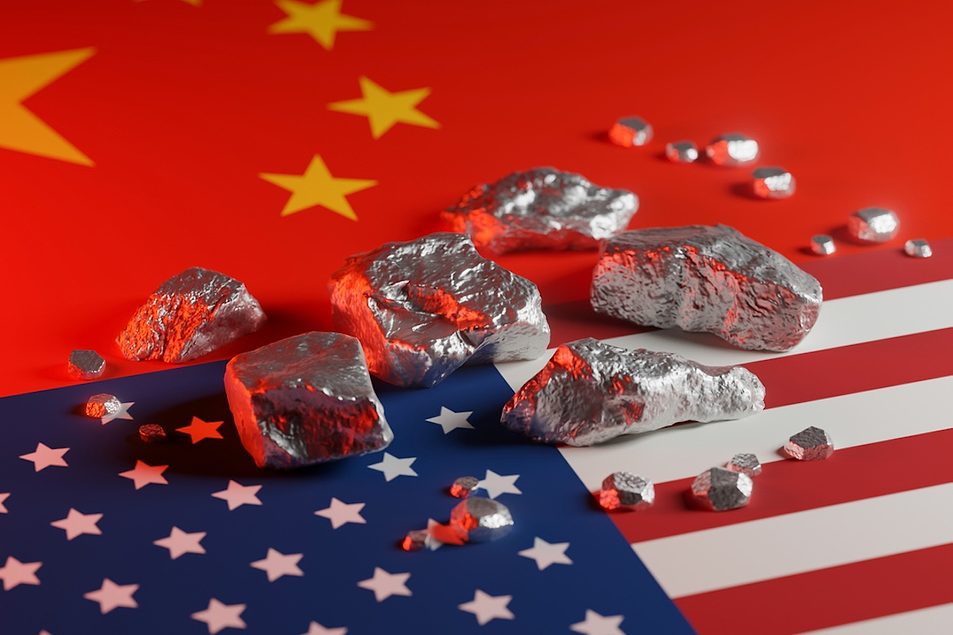
There’s no question that there’s a problem. China exercises a virtual monopoly over the rare earth and critical minerals that are essential to so many high-tech products consumed by Americans. Overall, the U.S. depends heavily on foreign producers for a broader range of critical minerals, as was highlighted in a recent report from the U.S. Geological Survey.
Read More: Podcast | Can the U.S. Ever Stop Relying on China for Critical Minerals?
Fixing the problem is a huge task, and President Donald Trump’s administration has made some bold moves recently in order to alter the balance of power. Whether they’ll have the desired effect is a matter of some debate.
Building up Reserves, Shifting the Market
In February, the White House announced two major critical minerals initiatives: Project Vault and the Forum on Resource Geostrategic Engagement (FORGE).
Project Vault — a public-private partnership funded by a $10 billion loan from the U.S. Export-Import Bank (EXIM) and nearly $2 billion in private sector capital — is intended as a physical minerals stockpile for civilian use. The goal is to protect the private sector from supply disruptions and price volatility.
According to the Bipartisan Policy Center, while a private company could, in theory, build its own individual stockpile, centralizing storage through a government‑backed public‑private partnership provides greater physical security and lowers the cost of holding inventory. Further, Project Vault’s structure would allow participants to hedge long‑term price risk by locking in fixed purchase rates, which is something companies cannot achieve independently without assuming significant financial risk.
In tandem, FORGE will replace the Minerals Security Partnership and will be chaired by the Republic of Korea until June. This trade bloc would set reference prices for minerals that would essentially act as price floors which would be enforced through adjustable tariffs. The proposal is intended to combat “dumping” below-market-price minerals by China. U.S. Vice President JD Vance said FORGE could provide an opportunity to create a “preferential trading zone for critical minerals.”
Peeling away from China wion’t be easy, though. It remains a dominant force, controlling more than 50% of production and roughly 87% to 90% of processing and refining for key materials such as rare earths, lithium, cobalt and graphite. In the processing of heavy rare earth materials, China accounts for 99% of the market. The ongoing trade tensions between the U.S. and China — with the world’s two largest economies exchanging barbs in the form of ever-changing import and export restrictions — mean geopolitics will continue to have a huge influence on what’s available and how much it costs.
It’s not just about China, though, notes Martina Raveni, senior analyst, strategic intelligence team at data analytics and consulting company GlobalData. “Myanmar’s political instability is disrupting China’s supply of rare earth elements,” said Raveni in a February 19 statement. “The rise of resource nationalism in South America is disrupting mining projects. Critical minerals are not just raw materials; they are strategic assets.”
As a result, the U.S. has paired stockpiling with a broader diplomatic push, most notably the inaugural Critical Minerals Ministerial in Washington, D.C. in February, which drew participation from more than 50 countries but excluded China and Russia.
Meanwhile, resource monopolization and geopolitics are only two of the four main supply-side risks faced by sectors that rely on critical minerals, according to a recent Strategic Intelligence report from GlobalData, titled “Critical Minerals.” The other two factors are mineral depletion, and environmental, social and governance (ESG) policies and strategies.
The report notes that the concentration of critical minerals in specific regions creates uneven resource distribution and volatile market dynamics. For example, much of the world’s lithium reserves are in South America; the Democratic Republic of the Congo (DRC) provides much of the world’s cobalt; and Indonesia dominates nickel production. Another leading source of critical minerals is Canada, which supplies aluminum, gallium, potash and zinc to the U.S.
So the U.S. isn’t just investing in domestic production and stockpiling; it’s also funding infrastructure and energy projects in South America and Africa — as is China.
A typical example is a partnership between the U.S. International Development Finance Corp., the U.S. government’s development finance institution, and Mercuria Energy Group, under which the Democratic Republic of Congo will ship copper to Saudi Arabia and the United Arab Emirates.
Public Money, Invested Privately
Is pouring public money into private enterprise the best way forward? Expert opinions differ.
Project Vault’s promised $12 billion strategic reserve of rare earths would reduce U.S. supply chain vulnerabilities, says Andrei Quinn-Barabanov, supply chain industry practice lead at Moody’s. But he warned that supply chain managers would still have two key concerns.
“One, a purchase of this size, even if spread over many months, could contribute to higher prices for critical minerals, affecting U.S. customers regardless of where the materials originate if there aren’t near-term plans to expand production capacity,” he says. “Two, a strategic stockpile is not designed to serve as an ongoing supplier. American companies would still need to continue to rely heavily on existing global production, until additional non-China mining and refining capacity becomes available.”
New capacity is unlikely to come soon. “We have an administration and Congress that have united around the need to de-risk our supply chains and reshore minerals production and processing, but it still takes an average of 29 years to bring a mine online in the U.S.,” said Rich Nolan, president and chief executive officer of the National Mining Association (NMA), in a press release responding to the Vault announcement.
“Over time, policy-backed demand may improve resilience and reduce exposure to disruptions, but it will not fundamentally alter global supply,” said Oxford Economics in a February 11 report.
Moody’s Quinn-Barabanov also saw the possibility that the commitments, whether at home or abroad, could end up simply being a sinkhole for taxpayers’ money. “Like any investment, there is no guarantee that money will not be lost. If the company is struggling to turn a profit, it will likely be asking the government to provide additional funding that can turn into an ongoing subsidy.” That would also render the U.S.’s pushback against subsidized materials from China somewhat indefensible.
While a reliable, long-term government contract to buy could give otherwise vulnerable businesses some stability, the success of companies extracting and refining critical minerals and other materials also depends on all the other key factors of business success, says Quinn-Barabanov. Those include management quality, employee motivation, competitors’ actions and the size of the market.
And, back to the Chinese: It’s not hard for the government to manipulate the market so that prices fall below the level where extraction and refining processes simply don’t make economic sense. “We’ve seen this happen before with other administrations, where the Chinese curb exports, and prices go up. Then it quietly calms down, and there’s an oversupply,” says Sebastien Tillett, economist at Oxford Economics. “You see violent price shocks when they turn the tap. There’s a risk of that happening again.”
Tillett says, however, that the Trump Administration seems to be deploying a genuinely long-term approach that takes extended lead times into account, and is showing a commitment to opening existing mines that are currently closed, at the least.
Although there are clear precedents for the U.S. government bailing out industries or companies that are experiencing a period of economic hazard (think Big Auto after the crash of 2008), or building up stockpiles of essential materials (such as oil and medical supplies), the current plan has some unusual factors.
“It seems unusual to take such explicit positions in private companies; that seems like a novel approach,” says Tillett. “What will determine if it works will be how long you stay in the game, and how long [that material] takes to come. So, the question is, Do they invest enough money or not?”
On one conclusion, supply chain and economics experts agree. Whatever the success of the current efforts to knock China off its pedestal when it comes to rare earth and critical minerals supplies, the best-case scenario, for the next decade at least, is reduced dependency, not complete independence. If the U.S. economy is going to continue to forge ahead based on data centers for artificial intelligence, lithium batteries for electronics, and a host of automotive and defense technologies, to mention a few uses of these materials, China will remain a critical trade partner, whether we like it or not.
For supply chain managers, that means the message is the same as it has been for a good long while, says Quinn-Barabanov. “Supply chain professionals need to have a backup plan for highly concentrated markets (like China with processed rare earths), particularly where there is insufficient spare capacity to relieve near-term pressure created by geopolitical developments.”