
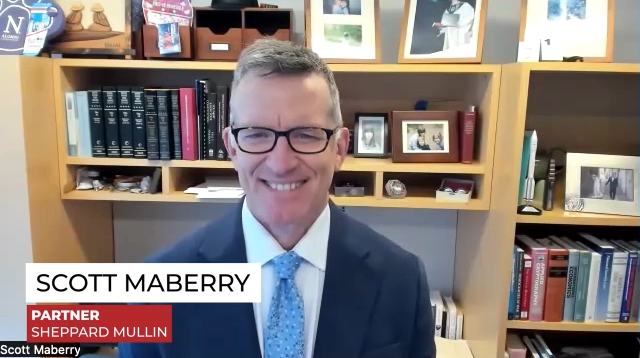
Scott Maberry, partner in the International Trade & Supply Chain team at the law firm of Sheppard Mullin, discusses how importers and exporters can cope with uncertainty caused by constantly shifting trade policies.
In response to President Trump’s promise to cut fentanyl-related tariffs to 10%, and overall duties on Chinese goods to around 47%, China has pulled back on previously announced restrictions on the exportation of products containing rare earth minerals. But that doesn’t mean that companies that rely on critical minerals from China can breathe a sigh of relief, Maberry says. China could once again bar access to those commodities at any time, and the U.S. could also impose strictures on trading with Chinese-controlled entities. Any of that could happen “with the stroke of a pen.”
Regardless of what happens between trading partners in the coming months, and whether the U.S. Supreme Court allows President Trump to continue invoking the International Emergency Economic Powers Act (IEEPA) as justification for his tariffs, high tariffs are here to stay for the foreseeable future, Maberry believes. Businesses need to proceed on that assumption, and begin taking steps to mitigate the impact of tariffs on their supply chains, while ensuring strict compliance with Customs rules. That includes accurate classification of imported goods under the Harmonized Tariff System
Technology, specifically in the form of artificial intelligence, stands to play a key role in ensuring the proper classification of imports. At the same time, Maberry says, companies need to sit down at the table with suppliers and renegotiate contract terms to allow for changes in the event of tariffs and other rising expenses. “There’s no rule that says the importer always has to continue to bear the cost” of a higher tariff burden, even if that entity is legally responsible for the initial payout.
Expect the coming year to be just as chaotic on the trade front as the last one, he says. “I don’t see any stabilizing influences.”